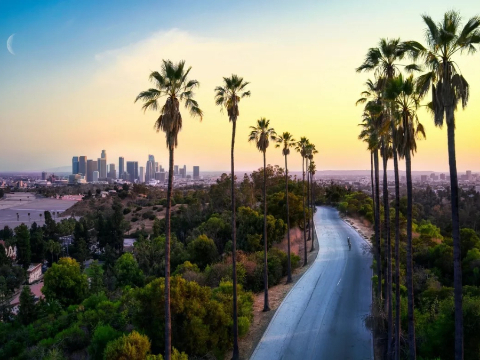
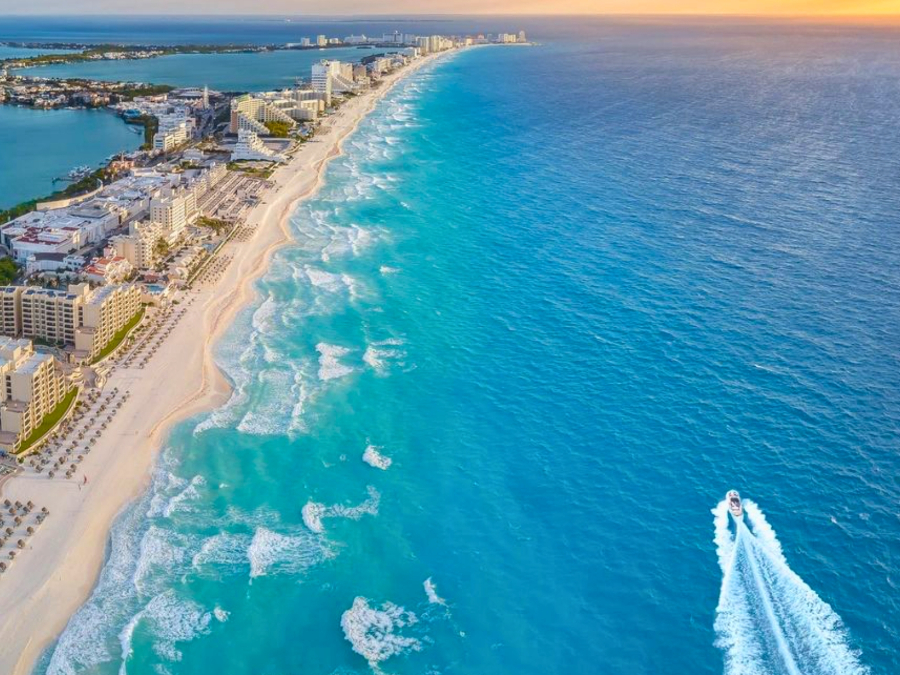
Coconut palms, a pleasant climate, white sandy beaches embraced by the ocean’s warm currents, and behind them a dazzling row of luxury high-rise hotels lining the shore.
America’s southernmost state is not only one of the world’s most renowned holiday destinations, but also a true paradise of waterways and wetland wildlife, the homeland of citrus fruits, an outdoor playground for nature enthusiasts, and a timeless favorite for family vacations. It is life on the sunny side.
Christopher Columbus caught sight of Florida’s shores just two years after discovering America. Even then, he sailed this way only in search of the Fountain of Youth, which was believed to be hidden somewhere in the region. It was not until the end of the nineteenth century that millionaires discovered the secret: the Fountain of Youth was Florida itself. Specifically, the eastern coast – the Gold Coast – where the millionaire Carl Fisher commissioned the construction of the first hotels in 1890. Miami was still only a little more than a modest village when the railroad tycoon Henry Flagler extended his rail network to the area. The first tourists arrived in the closing years of the nineteenth century, but the true boom came only after the Second World War. Miami soon became a busy hub linking the Caribbean and South America.
Retirees, world-famous celebrities, and adventure seekers.
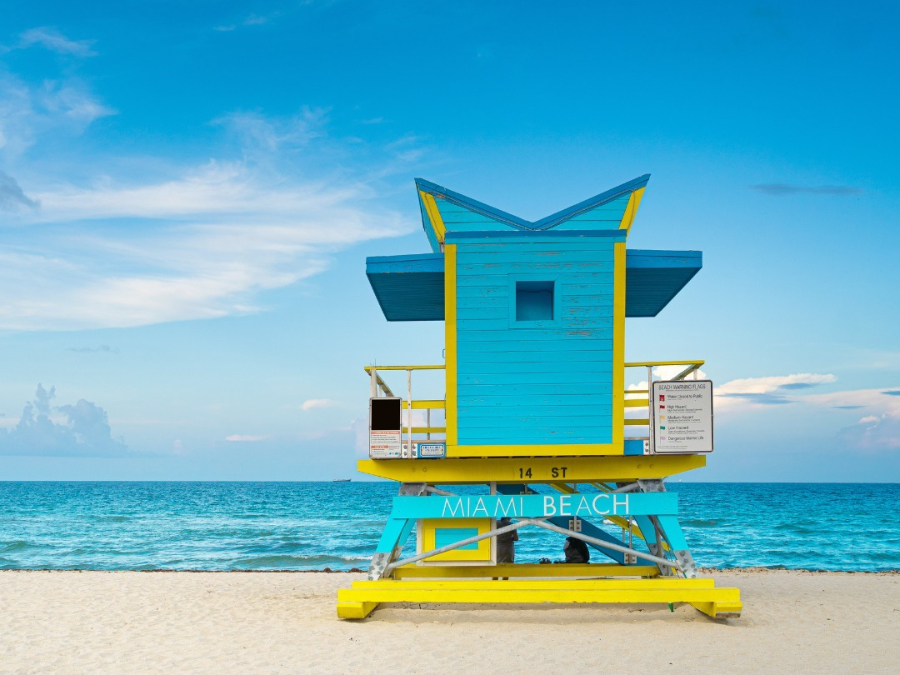
Thanks to American TV series, almost everyone can easily picture the colorful lifeguard towers watching over swimmers in the Atlantic Ocean, as well as the palm trees lining the boardwalks. Yet despite these vivid cinematic impressions, seeing it all in person is a completely different experience. The oceanfront is so captivating that it constantly draws breathless moments of awe from visitors.
Florida is not simply the southernmost state of the United States; it is rather a world bathed in light, where breathtaking natural beauty, the symbols of affluence, and the human desire for a carefree life all come together in one place. Those who travel here quickly begin to feel the lightness of life that defines the region. The sun does not seem to be in a hurry, the air never truly cools down, and time itself appears to flow more slowly in the shade of the palm trees. Miami, Fort Lauderdale, Orlando, and the Florida Keys are all different chapters of the same American experience – stories of luxury, freedom, and endless summers.
It’s no coincidence that Florida is the number one choice for retirees. Life is easier here. Meeting new people comes naturally, especially compared to big cities. The warm climate keeps heating bills low, everyday living costs are more manageable, and exploring the area is effortless. Many retirees simply jump into an RV – whether they own it or rent one – and hit the road. With so many attractions nearby, there’s always somewhere to go, and even on the quietest days, a walk along the beach can feel like a holiday.
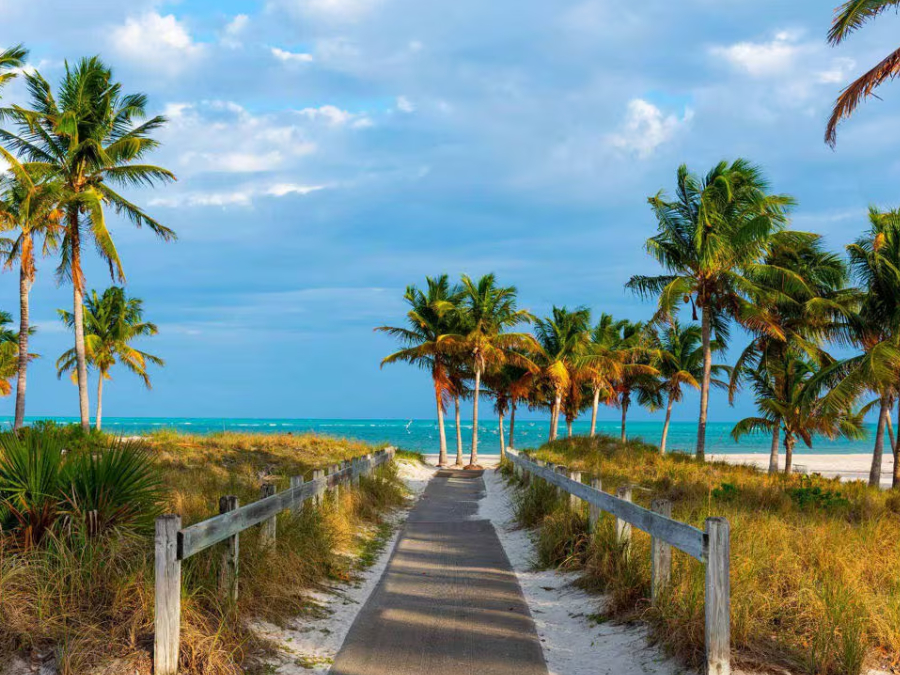
The sunlight that gilds the lives of retirees also brings in enormous profits for others. Miami is an El Dorado for bankers and real estate speculators. Alongside America’s so-called “eternally young,” South American multimillionaires and drug lords also spend their money here. Spanish is gradually becoming just as common as English. Tourism has been booming for decades, and even Hollywood celebrities have been drawn into the hotel business. Local guides are quick to point out celebrity ties to various hotels and venues – whether it’s Gloria Estefan and her husband, Pharrell Williams, or the lingering legend of a nightclub associated with Prince in the 1990s.
The oceanfront promenade is captivating at any time of day.
Early in the morning, the beautiful palm-lined seaside walkway of Ocean Drive is still almost empty. In the soft light, only a few rollerbladers and joggers are out. The atmosphere feels strikingly familiar – recalling recurring scenes from Miami Vice and CSI: Miami. Being part of such a cinematic moment feels almost unreal.
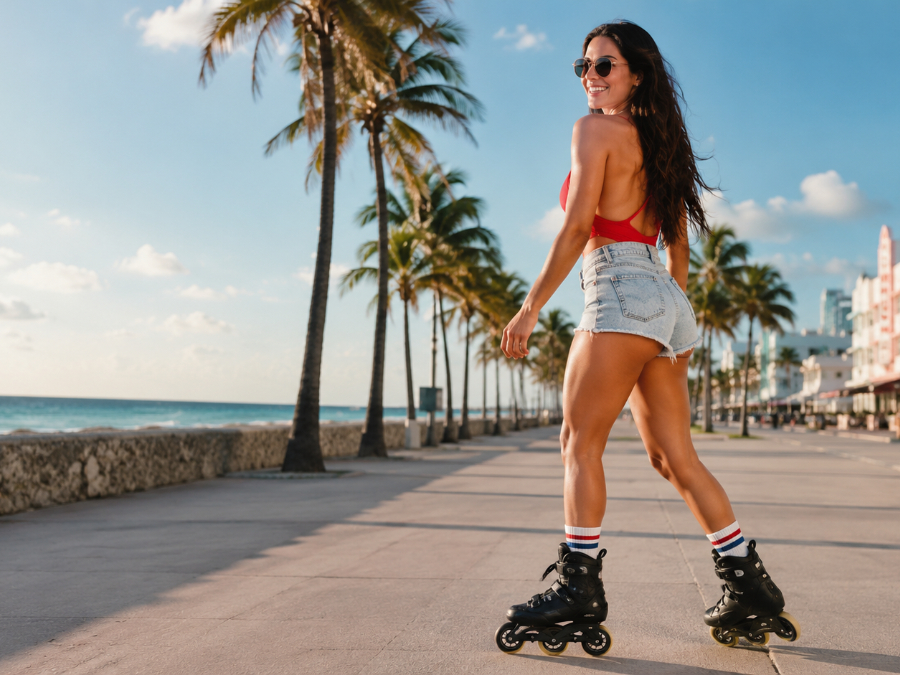
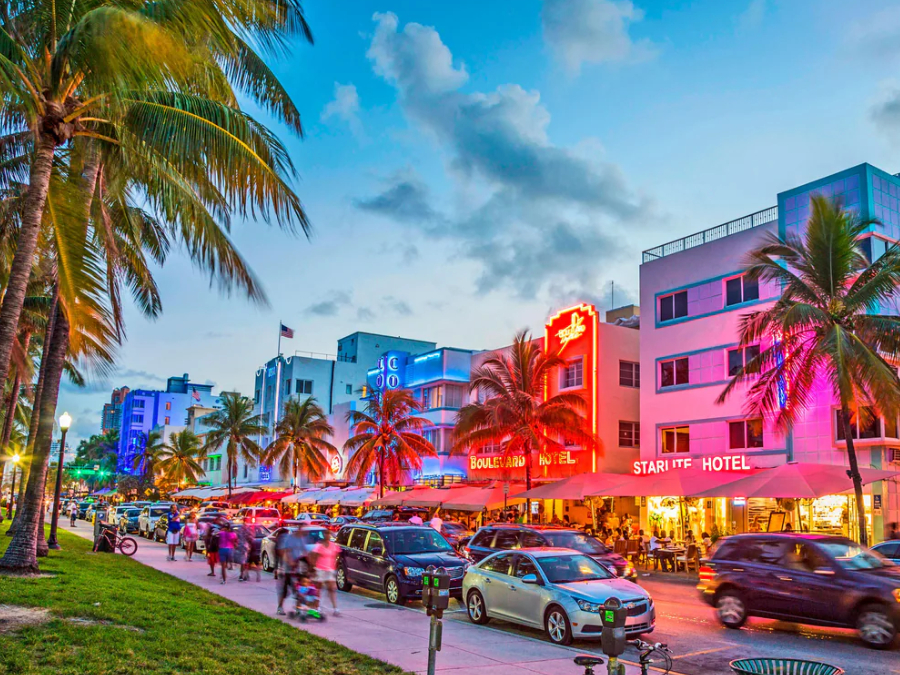
By day, the pastel-colored Art Deco façades of Ocean Drive almost glow – pale pink, mint green, and cream walls softly reflecting the sunlight – while crowds of visitors, drawn by the promise of the American coastal lifestyle, absorb the atmosphere along the promenade. The ocean is just a few steps away, and the sound of its waves can be heard even from the terraces of cafés and the verandas of boutique hotels.
In the late afternoon, Ocean Drive transforms once again. Lounge music grows louder, and the city’s most famous street begins to feel like one long, sun-soaked social gathering. Classic American sports cars, guests wrapped in the scent of perfume, and the hum of overlapping conversations all become part of the same choreography. As night falls, neon lights come to life, and the outlines of the Art Deco buildings form a stage set beneath the sky. The music intensifies, the rhythm thickens, and the air turns warm and slightly salty from the nearby ocean.
Designer luxury
Miami’s most exclusive shopping experience is not found in a traditional “shopping street,” but in an entire luxury district where architecture, fashion, and contemporary art come together in a single space. This place is the Design District – Miami’s ultimate high-end hub for fashion and design.
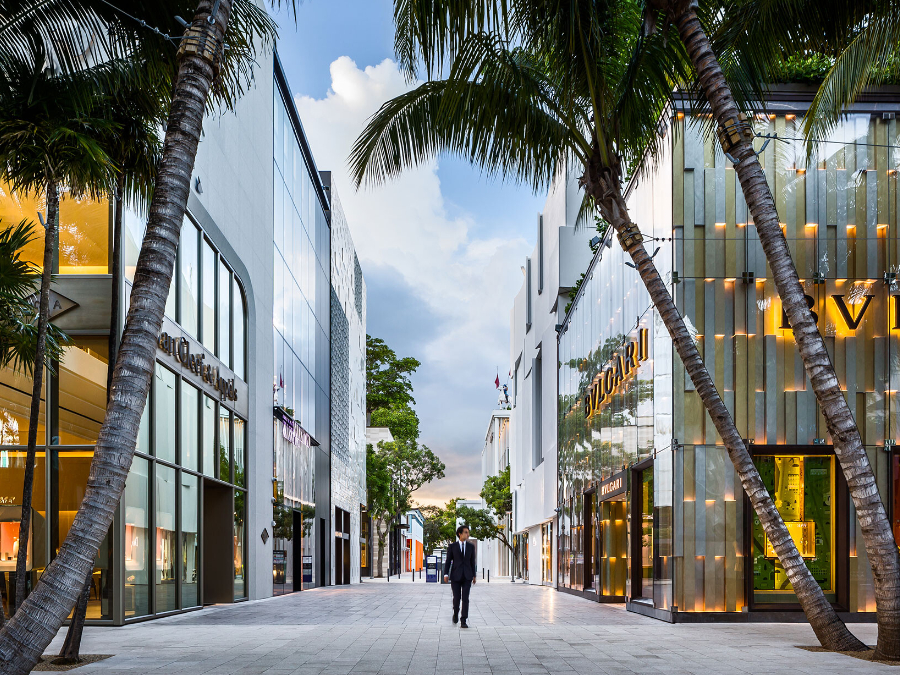
Visitors don’t come here simply to shop. Along the wide, palm-lined streets, futuristic buildings, glass façades, and carefully curated installations alternate, as if one were walking through a permanent contemporary art exhibition. This is where the highest concentration of flagship boutiques can be found, along with striking architectural statements and the kind of cutting-edge luxury that has made the district world-famous.
Along NE 39th Street – the backbone of the district – iconic stores from the world’s leading fashion houses line up one after another, often functioning as standalone architectural statements rather than conventional retail spaces. Instead of simple storefronts, they offer fully immersive brand environments. Here, names like Gucci, Louis Vuitton, Prada, and Dior are not merely present; they build their own “mini-universes,” where the interior design is just as important as the collections themselves.
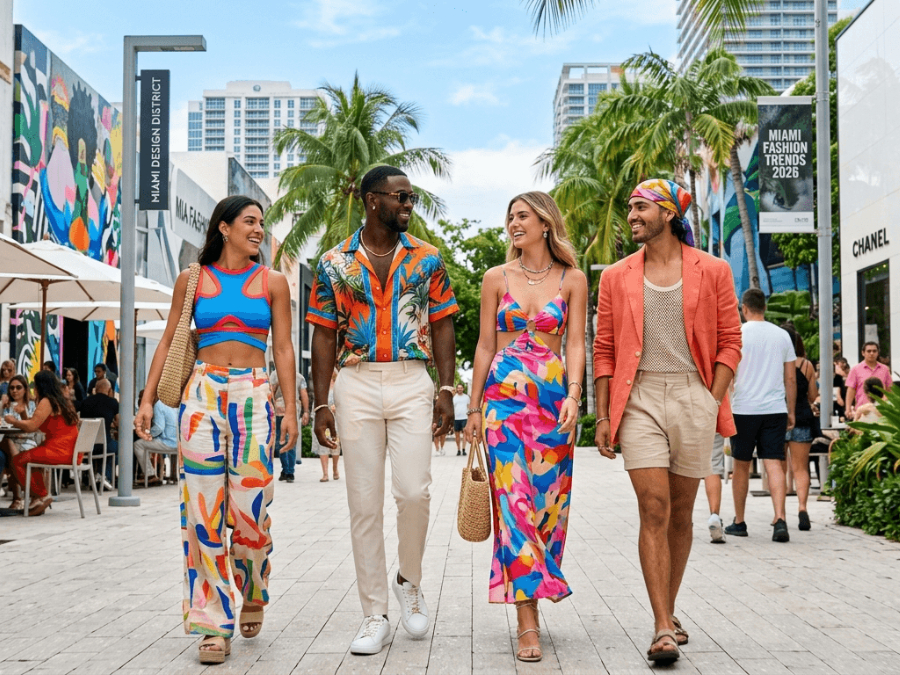
What makes the Design District truly distinctive is that it elevates the shopping experience to an entirely new level: private styling services, personalized showroom visits, and VIP lounges are all standard here. It is not uncommon for individual brands to offer dedicated reservation systems for returning clients, turning shopping into an exclusive event rather than a conventional retail experience.
The district’s culinary scene is equally high-end. Michelin-recommended restaurants, designer cafés, and rooftop fine dining venues sit side by side, making it easy for a day of shopping to turn into an all-day luxury experience. What truly sets this part of Miami apart is that luxury here is not limited to branded goods – it is embedded in the very experience of the space itself. The public areas feel sculptural, with a constant flow of art installations, and the entire district functions like a living gallery where fashion, design, and lifestyle converge.
Are we in Madrid, or in Cuba?
Those visiting Miami for the first time are often surprised by the constant presence of the Spanish language. Where are we exactly – Madrid or Miami? they wonder when they arrive at Española Way, the “Spanish village” of the city. Its buildings are designed in a pure historic Mediterranean Revival style, complete with fountains, cafés, small shops, and a colorful weekend market. The Coral Gables district is an architectural mix of international influences. The iconic Biltmore Hotel, evoking the city’s grand past, is modeled after the Giralda tower in Seville. The swimming pool carries a Venetian atmosphere, while Dutch and French stylistic elements blend in surprisingly with South African and Chinese influences. Little Havana – a small piece of Cuba – is where the first waves of emigrants arrived after Castro’s revolution. Most have since moved elsewhere, replaced by Colombians and Nicaraguans, but the atmosphere remains largely unchanged. The neighborhood radiates Latin joy, with houses painted in yellow, red, green, and blue, a lively marketplace, and the picturesque Puerto Príncipe, where colorful fruits and dried fish are sold.
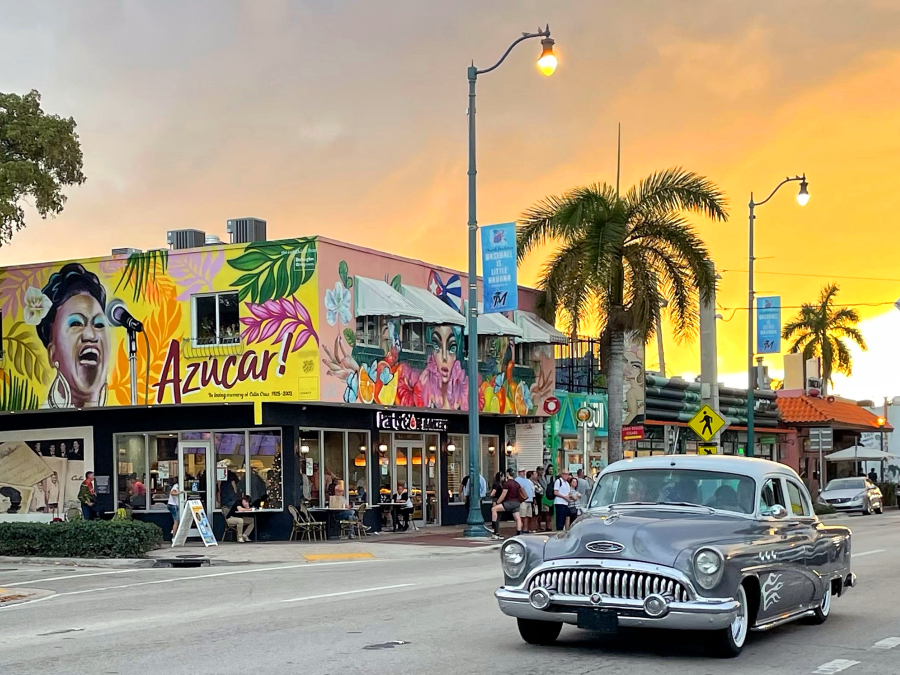
On its main street, Calle Ocho, Cuban specialties dominate the restaurant menus. You can eat black beans with roast pork, while a smiling waiter brings Hemingway’s favorite cocktail, the daiquiri. It feels as if I were truly in Havana. Latino communities occupy an ever-larger presence: there is now everything from Little Haiti to Little Nicaragua, Little Bogotá, and Little Caracas. They are the true kings of the nightlife scene – excellent musicians, DJs, and dancers – who liven up the often-bored wealthy elderly American women.
When the sun sinks below the horizon and paints the blue sky deep red, the neon lights switch on and the bands begin to play. Energetic Afro-American rhythms blend with hot Latin melodies; saxophones cry out, while dance, techno, jazz, and house music all mix together. Clubs, bars, and lounges line up one after another. One of the most iconic is the historic Ball & Chain. Opened in the 1930s, this jazz club was one of those open-minded venues where, during the years of segregation, celebrated Black musicians such as Billie Holiday and Nat King Cole performed. The club closed in the 1950s and, until its reopening ten years ago, operated as a furniture store. Today, it is once again one of the city’s most popular meeting points.
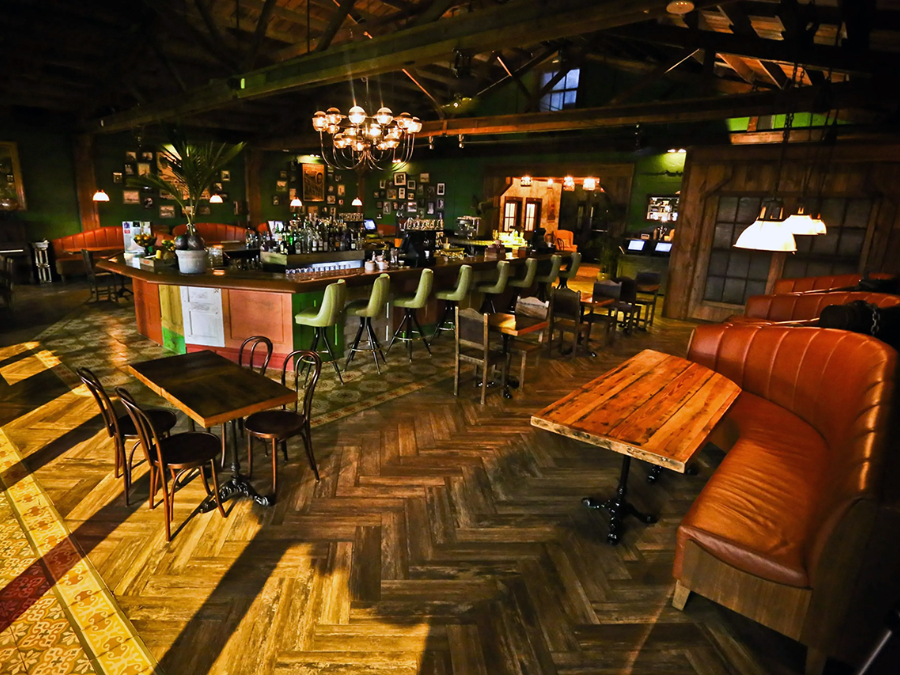
The night in Little Havana is filled with the sounds of dance clubs: everyone is dancing salsa, rumba, mambo, and merengue. There are also venues where VIP rooms can be rented, complete with leather sofas and full service, for the entire night.
Miami Beach, the Pearl of the Ocean
Strangely enough, Miami isn’t one city – it’s two. One is the original city itself, Miami, the “mother city” that grew from a small town into a major metropolis. Attached to it is Miami Beach, a holiday paradise built on several smaller artificial islands. At the end of the 19th century, this narrow strip of land was still a coconut plantation. The island’s development was triggered by the construction of the first bridge reaching all the way to the mainland – a two-and-a-half-mile wooden bridge. Soon after came the first hotels in the 1920s: the Flamingo Hotel, the Fleetwood Hotel, the Floridian, and the Roney Plaza Hotel. The rest, as they say, is history.
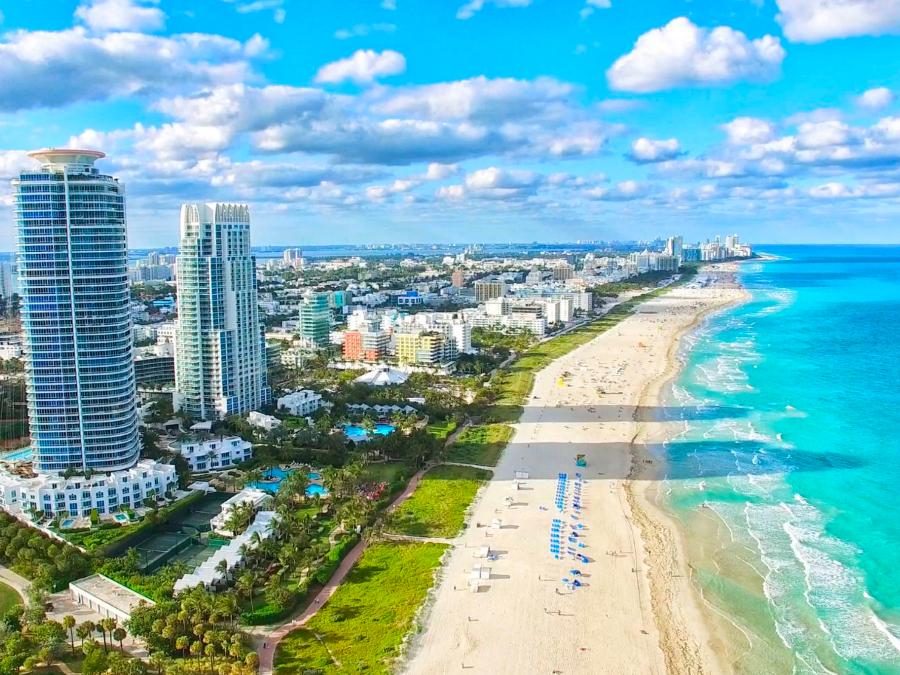
Miami Beach today remains an endless delight for sun worshippers and swimmers, with its white sandy beaches backed by a striking skyline of towering luxury hotels. Its most beautiful and elegant district, South Beach – known locally as SoBe – hosts surfers gliding across the Atlantic waves. Here lies Ocean Drive, home to the distinctive Art Deco District: more than 960 buildings dating from the 1920s and 1930s. Fantastical forms, pastel colors, sidewalk cafés, restaurants, shops, and stylish nightlife venues create a vivid glimpse into a not-so-distant past that sought to reinvent itself through bold and unconventional design.
Miami Beach is also where the most exclusive luxury resorts are found. With carefully composed spaces and impeccable service, oceanfront locations come as part of the experience by default. Iconic hotels such as The Setai Miami Beach, the Faena Hotel Miami Beach, and 1 Hotel South Beach stand out even among high-end offerings. The Setai embodies Asian-inspired serenity, the Faena expresses bold artistic and design-driven extravagance, while 1 Hotel offers a nature-focused, sustainable form of luxury. Each represents a completely different world, yet all serve the same refined lifestyle.
Here, resort life begins on private beaches, where dedicated beach hosts, ice-cold towels, freshly prepared cocktails, and uninterrupted ocean views await guests. In the secluded comfort of private cabanas, luxury service is a given – everything is provided before it is even requested.

A few minutes to another world.
The experience world of Everglades National Park reveals a completely different side of Florida compared to the glitter of its coastal cities. There are no skyscrapers, no neon lights, no elegant boulevards – only endless stretches of water, mangrove forests, and an authentic, lush wilderness. This is the mysterious and sometimes dangerous realm of swamp forests, a perfect habitat for alligators that can easily be mistaken for decaying tree trunks. There are no conventional roads here; the Everglades is a “river of grass,” where travel is only possible by airboat. It is not advisable to venture out alone in search of alligators, as these nearly motionless reptiles, barely visible in the swamp, can strike with astonishing speed if they sense prey. With a professional guide, however, it is safe to explore.
The adventure begins the moment you arrive. The airboat slices across the shallow waters and grass-like marshlands as if it were gliding above them. The landscape is in constant transformation: one moment it is open water reflecting the sky, the next you are moving through towering stands of sawgrass. The speed is dizzying, and after the roar and vibration of the engine, it is almost a relief to pause in the middle of the marsh. Life above the surface is subtle, but beneath it everything is in motion – turtles, wading birds, and of course the iconic alligators.
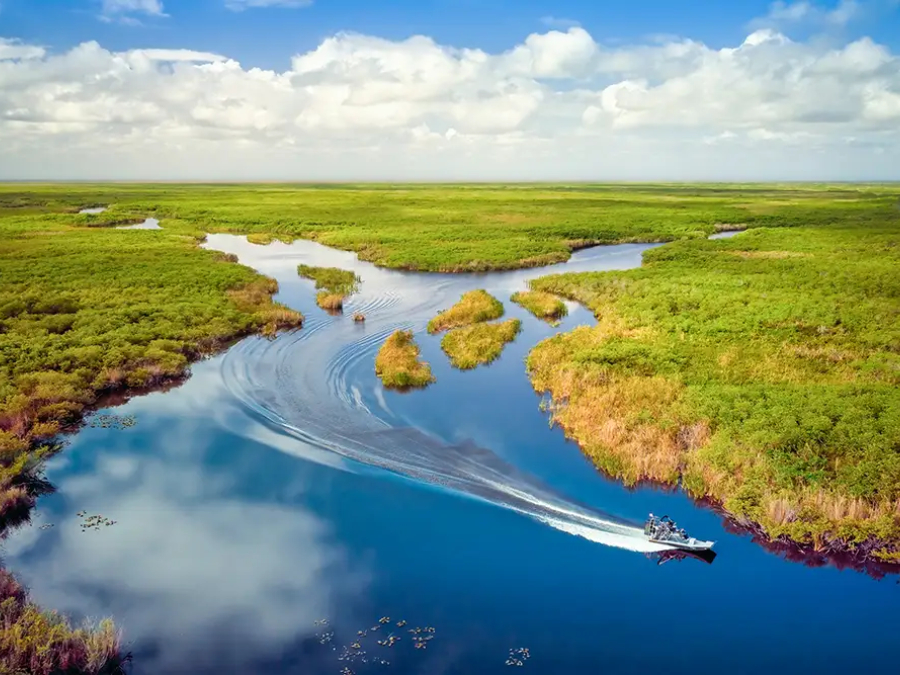
One of the most striking moments on guided tours comes when you first hear the silence that surrounds you after the airboat stops. A distant bird call, the gentle ripple of water, or the rustle of vegetation beneath the surface of the boat becomes far more intense than any urban noise.
Luxury experiences are also available here. Private eco-tours, wildlife photography expeditions, and sunset cruises are not only exceptional in terms of experience, but also in the level of service they provide. Exclusive tour operators offer experiences that allow visitors to enjoy close contact with nature while still preserving its untouched and authentic character.
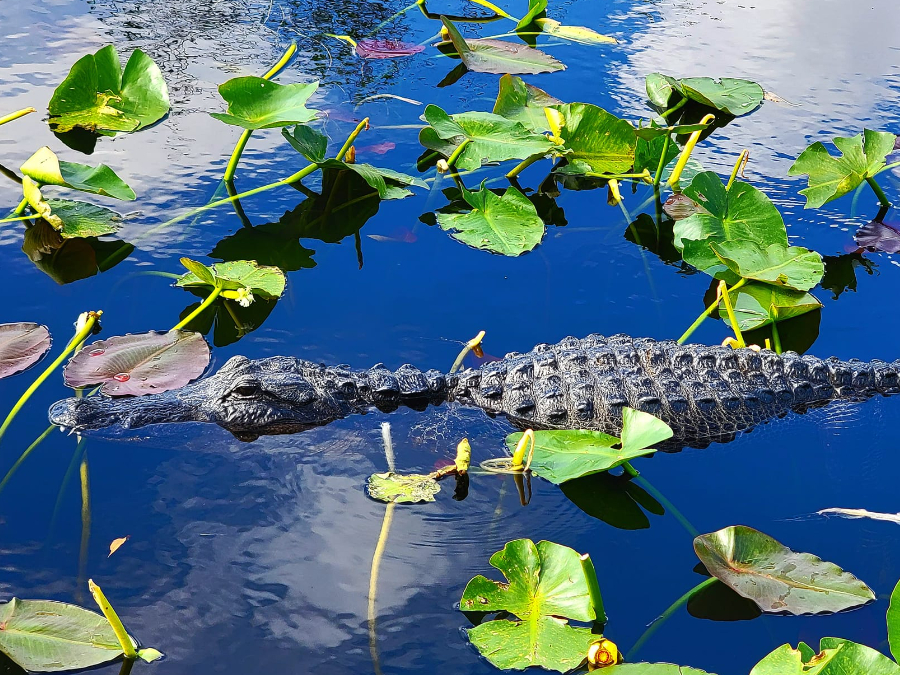
As the sun sinks below the marsh horizon, the Everglades shift into almost surreal colors. The water turns from gold to copper, then deep indigo, while the edge of the horizon blends into the endless flat expanse. It is the moment when the landscape seems to surround you completely and quietly absorb you.
The Everglades is not a place designed for casual “visiting.” It offers a genuine and profound connection to nature, one that makes Florida’s glittering built environment feel even more striking by contrast. Anyone who glides across this watery world does not simply see a national park – they encounter one of America’s last truly untouched landscapes.