Borgo Scopeto Wine & Country Relais is extraordinary not simply because it is a stunning luxury hotel. It is extraordinary because, during your stay here, you rediscover something that is all too easy to lose today: what it truly means to be present.
Anyone who has been to Tuscany or wandered through the hills of Umbria knows that the Mediterranean landscape has a scent of its own. It isn't the fragrance of a single plant or flower. It's the sunshine, stone basking in the sun, dry grass, freshly harvested wheat, olive groves, and dusty country roads. One of the most distinctive scents found here is lavender, the fragrance of which changes completely in the afternoon.
It is a truly distinctive scent, one that stays with you forever, becoming inseparable from the memories and emotions of time spent in this landscape.
Whenever people ask me what Tuscany means to me, I always begin by talking about this. And as I do, the memories come rushing back, reminding me why people are so deeply drawn to the world's most captivating countryside. It isn't simply for the scenery. Nor is it for the luxury. It's for those rare moments when the scent of a sun-soaked landscape, a glass of wine, and the serene atmosphere of a summer evening suddenly make you feel completely at home.
Borgo Scopeto Wine & Country Relais is more than just a luxury hotel. It is the embodiment of this unique Mediterranean way of life. It has an atmosphere of its own, one you notice the moment you arrive on a hot July afternoon. As you step out of the cool air-conditioned car, the warmth greets you. Not the suffocating heat of a city, but the dry, sunlit air of the Mediterranean. The resinous scent of the cypress trees mingles with lavender, rosemary, and the subtle green aroma of the olive trees, made complete by the warm smile of the host who comes to welcome you.
It feels as we've come home, even though it's our very first time at Borgo Scopeto.
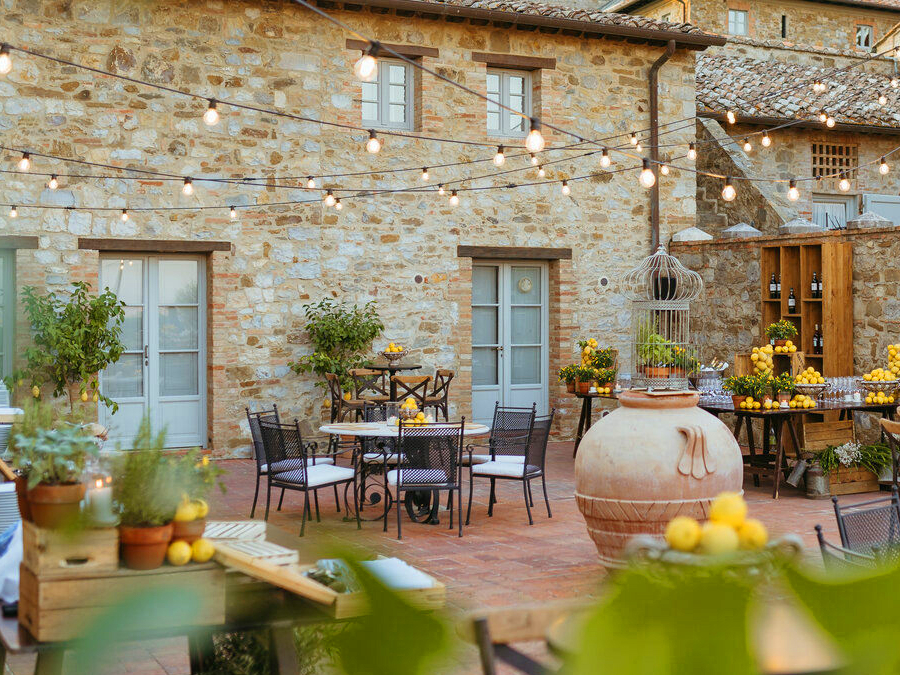
There are luxury hotels in the world that can be described in a factual, almost catalog-like way. You can list their services, the number of rooms, their star ratings, the size of the pools, the length of the wine list, or the facilities offered by the spa. In contrast, there are places that somehow escape the world of facts and figures. Places that are less like destinations, but more like feelings. Like a memory you've carried with you for years without ever realizing it existed, until the moment you arrive.
Borgo Scopeto Wine & Country Relais is one of those places.
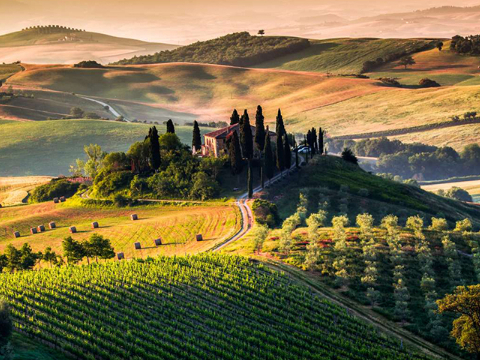
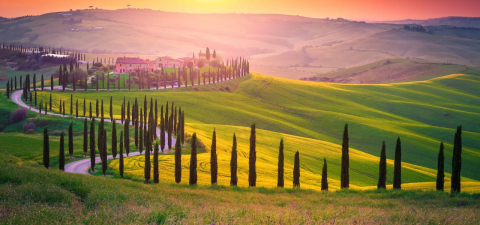
Even the drive there feels cinematic. Neatly ordered rows of vineyards follow the curves of the hills, the silvery leaves of the olive groves glimmer in the sunlight, and the wind stirs up dust above the freshly harvested wheat fields. The entire landscape carries an indescribable sense of calm, a quiet peace watched over by the cypress trees lining the roads, standing like disciplined soldiers who have kept guard for centuries. The noise of the modern world gradually fades away. Almost without thinking, we switch off the radio, and even the map on our phone begins to draw less of our attention. Before we realize it, we're breathing more slowly.
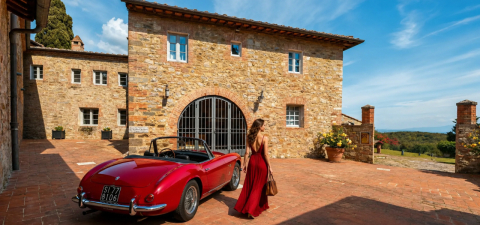
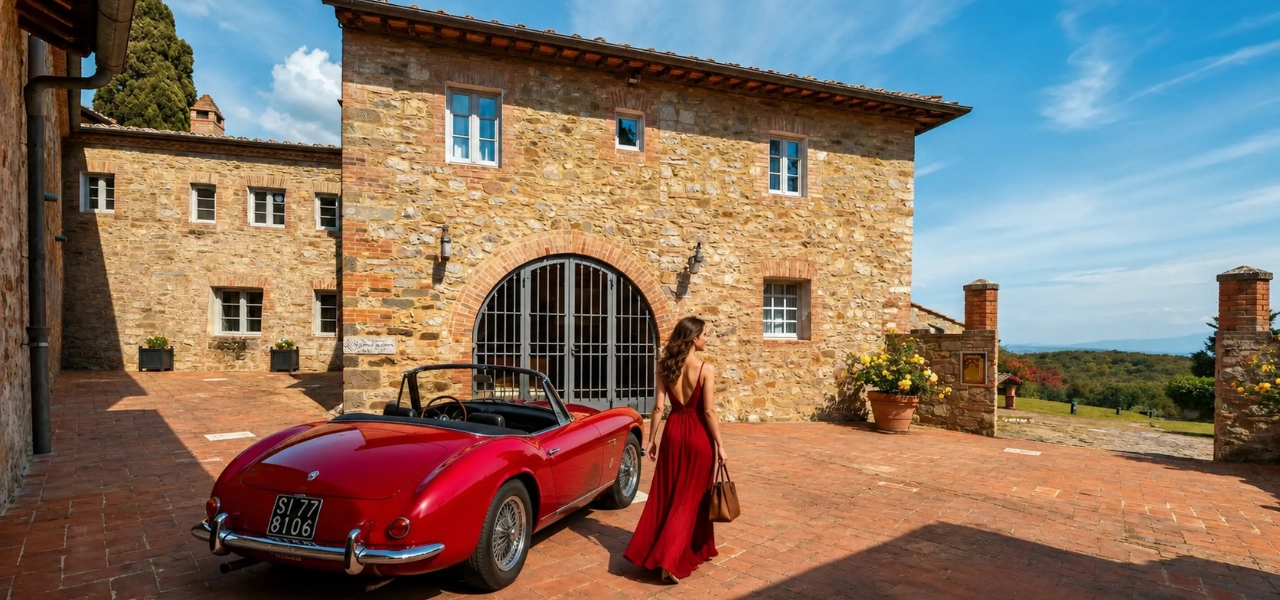
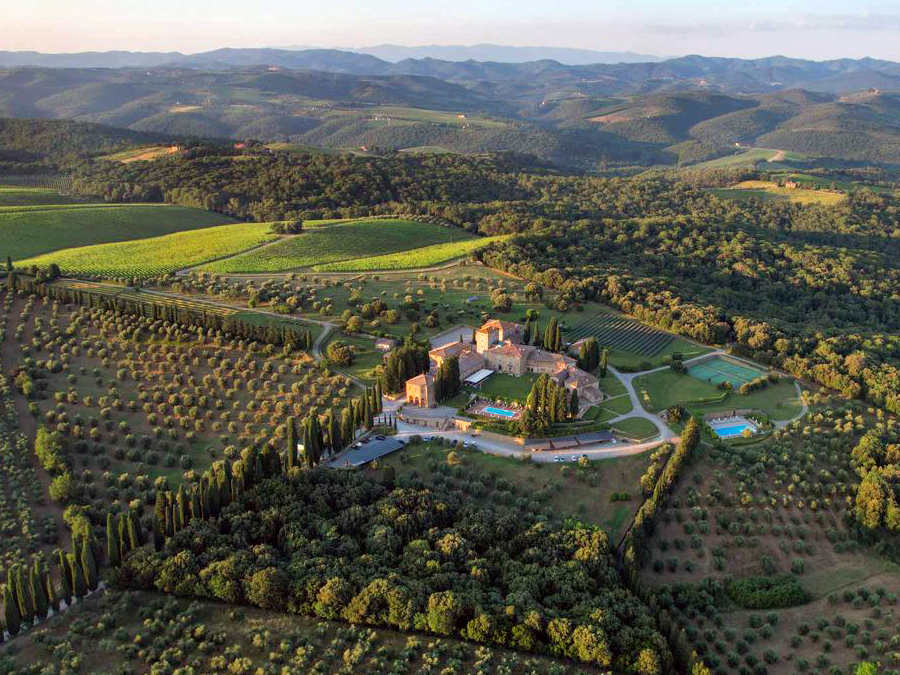
Then, suddenly an estate comes into view. The five-star Borgo Scopeto Wine & Country Relais is, in fact, a tiny medieval village that seems to have been forgotten by time. Stone walls, towers, shaded courtyards, a chapel, flower-filled terraces, and that kind of timeless elegance that no architectural concept can recreate. It is the kind of beauty that can only be shaped over centuries.
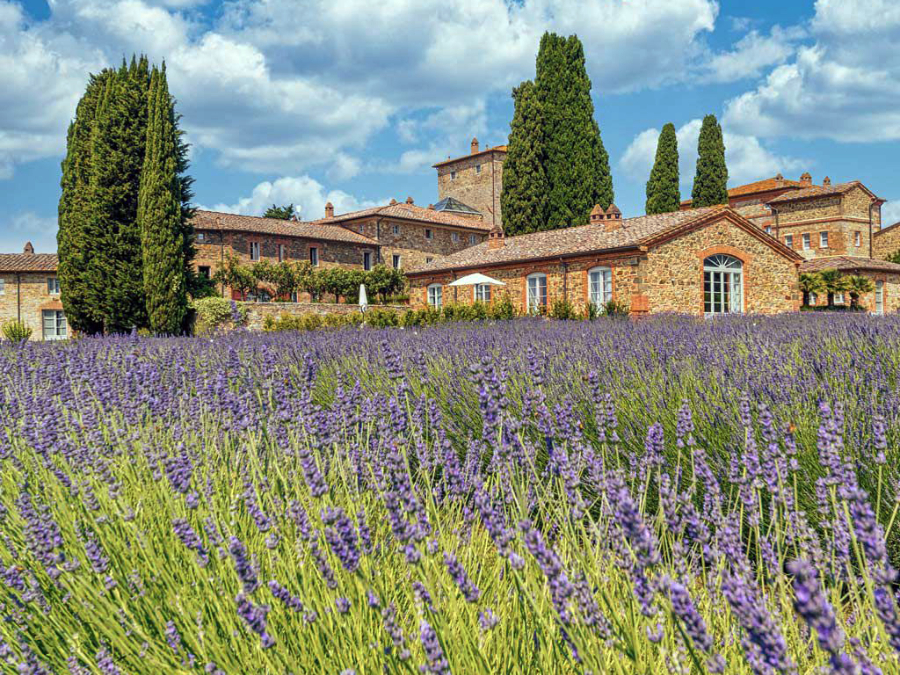
Its history stretches back almost a thousand years. The earliest records date deep into the Middle Ages, and as you walk through its streets, you don't just know that, you feel it. The stones seem to have a memory of their own. They have preserved the footsteps of merchants, the stories of noble families, the joy of bountiful harvests, and the conversations of long summer evenings. There are few places in Europe where history surrounds you not as something displayed in a museum, but as a natural part of everyday life.
Everything is exactly where it belongs
The rooms and suites speak a language of understated luxury, while the villas feel more like welcoming homes than places designed to impress through excess. Nothing feels forced. Terracotta floors, exposed wooden beams, carefully restored stone walls, and elegant furnishings come together in a harmony that is both authentic and refined. Looking out the window, you're greeted by sight of vineyards, cypress trees, and in the distance, the towers of Siena rising on the horizon.
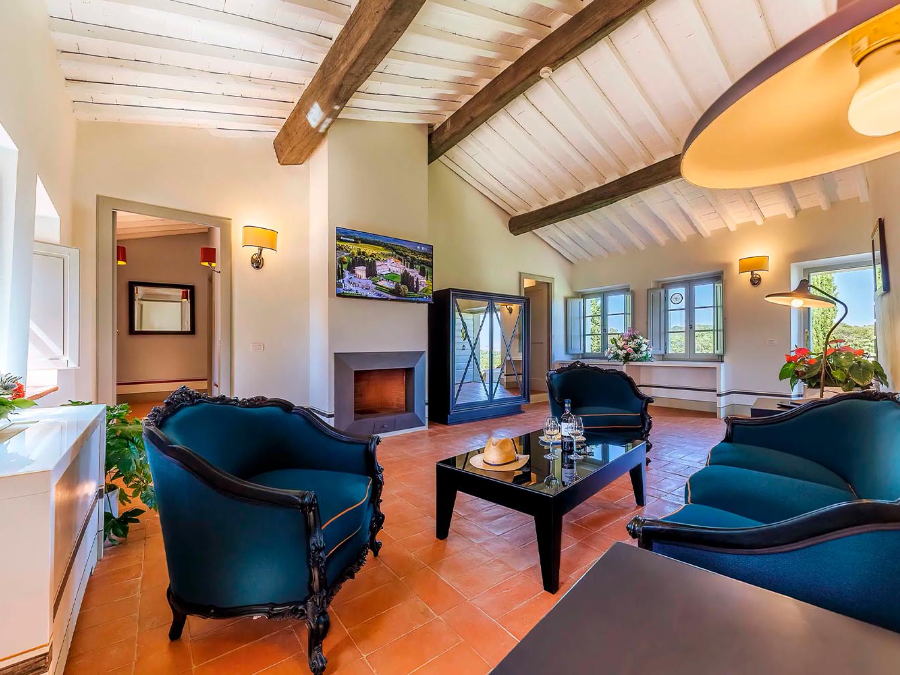
It's a view you'll never forget. In the morning, as the first rays of sunlight turn the hills golden, the landscape looks as though someone has placed a Renaissance painting outside your window. The air is still cool. The aroma of freshly ground espresso mingles with the scent of flowers from the garden. As we wait on the terrace for our truffle omelet, the gentle rustling of leaves and the birds' melodious songs fill the morning. It is the kind of peaceful silence in which we are finally able to hear our own thoughts again.
Perhaps this is Borgo Scopeto's greatest gift. It offers more than relaxation, it gives back a sense of peace that we gradually, almost unknowingly, lose in everyday life. The surrounding Chianti Classico countryside represents one of Tuscany's noblest landscapes. Here, winemaking is more than a business. It is a mix of culture, identity, tradition. The vineyards carry forward the knowledge of generations. Every bottle reflects the land, the sunshine, the work of human hands, and the unique character of its history.
Walking through the vineyards is a special experience. The gentle rhythm of the rolling hills is almost hypnotic. The wind moves softly through the vines, while Siena's medieval skyline rises on the horizon in the distance. The landscape seems so perfect that it hardly feels real. Almost instinctively, we reach for our phones to capture it all. But then, something quietly changes within us, as we feel less and less compelled to experience the view through a screen. That is when we truly understand the magic of Borgo Scopeto, not when we save it to our phone's memory, but when we simply allow ourselves to experience it with our own senses.
To live slow, is to live well
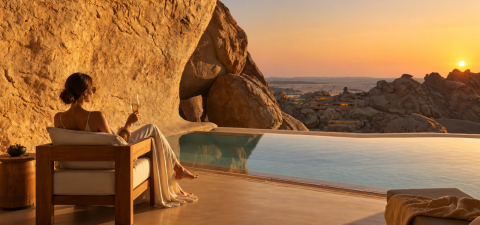
As we walk out to the panoramic pool, we feel the warmth of the sun and the touch of the Tuscan breeze on our skin, carrying with it the scent of cypress trees, lavender, and sun-baked earth. The water lies perfectly still, reflecting the sky, while the rolling hills in the distance fade into a soft blue haze.
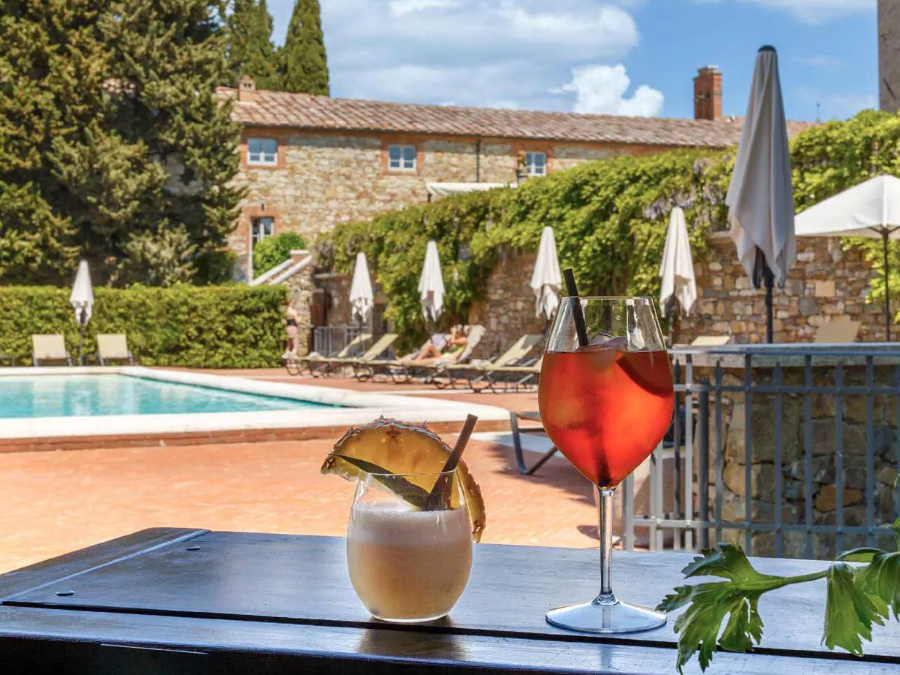
The icy freshness of a cocktail from the bar brings us back to the moment. Tiny droplets of condensation slowly run down the side of the glass. A hint of citrus, a touch of mint, the quiet clink of ice: these are small details that would seem insignificant in everyday life, yet here they somehow become more vivid, more complete. At first, the feeling is surprisingly unfamiliar. But as our inner rhythm gradually slows, it becomes easier to notice the beauty hidden in the smallest details and to fully appreciate the magic of fleeting moments.
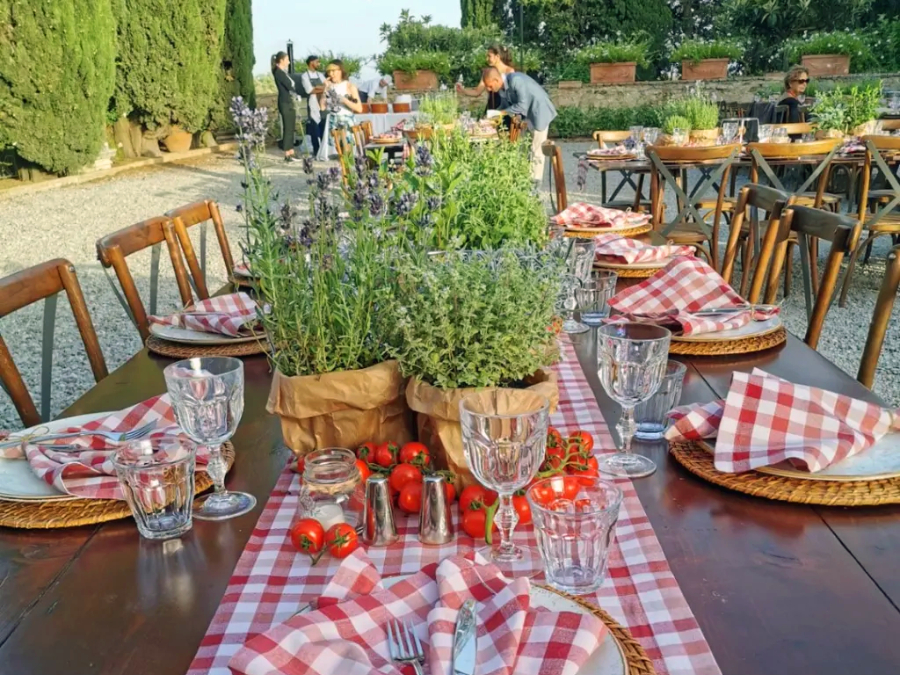
As evening approaches, the light begins to change. This is the Tuscan golden hour that has been photographed countless times, yet can never truly be captured. Resting on the horizon, the sun slowly and gracefully says goodbye. The shadows stretching across the vineyards grow longer and darker, the stone walls take on a honey-colored glow, and Siena's distant towers seem to float on the horizon like part of a painting.
At this hour, a special sense of calm settles over the estate: The distant clink of glasses from a terrace. the murmur of friends in conversation, and the wind moving through the trees. The aromas drifting from the kitchen are simple, yet distinct; fresh bread, rosemary, grilled meat, and olive oil invoke a special sense of calm in us.
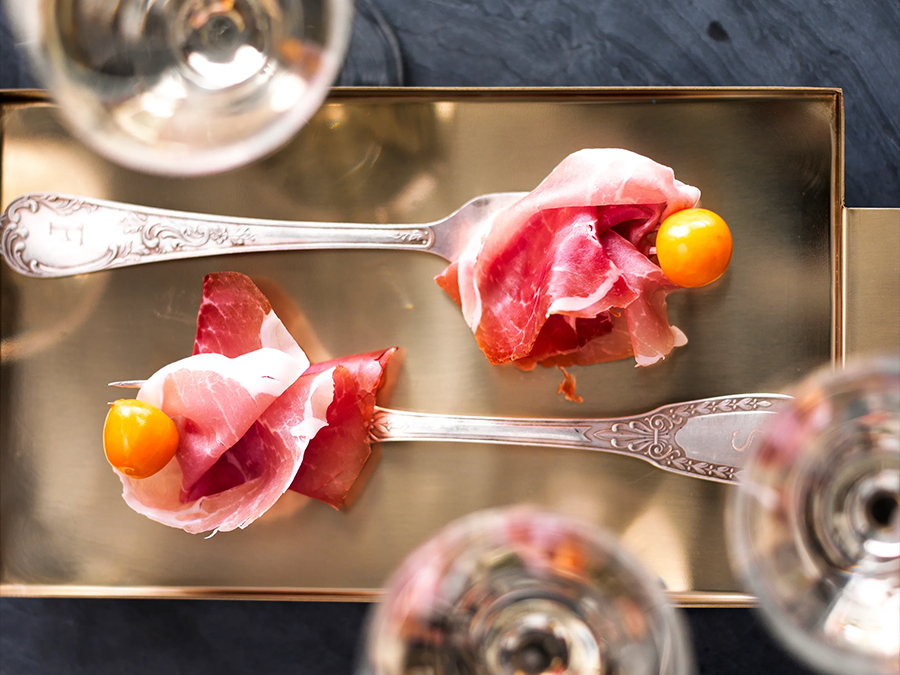
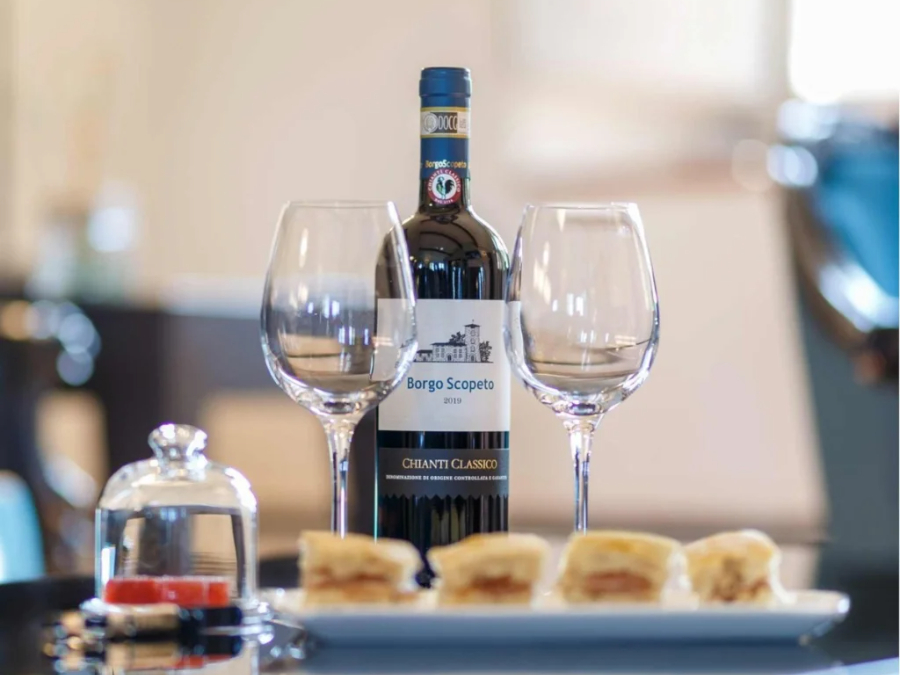
One of the greatest secrets of Tuscan cuisine lies in its simplicity and balance of flavors. It is never overcomplicated. It simply begins with exceptional ingredients. A perfectly cooked steak, accompanied by a glass of deep ruby-red Chianti Classico, is enough to make you realize that luxury is rarely about excess. It is about quality. Time. And attention to detail.
Then night falls. The sky slowly deepens from dark blue to black, and the landscape that glowed all day reveals an entirely different side. The stones hold the warmth of the sun for hours and the air remains pleasantly mild. We sit out on the terrace with one last glass of wine, and suddenly we notice something we might no longer even hear at home: the sounds. The sounds of a summer night, the chorus of cicadas, part of that continuous, unmistakable noise of a Mediterranean summer evening. It is the quiet of a living landscape, the kind of peace that makes you feel that everything is exactly as it should be.
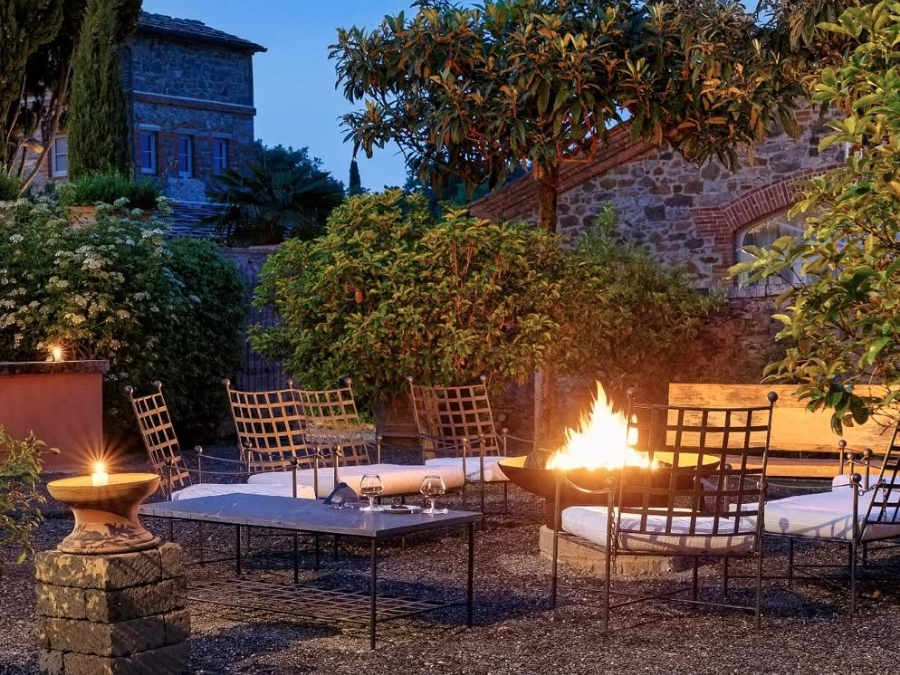
Perhaps that is why Borgo Scopeto is so difficult to write about. Because any description inevitably falls short of what it truly offers. You can describe the views, the rooms, the pools, the wines, or the cuisine. But its essence lies somewhere beyond all of those things. It is found in a feeling that you start to feel on the very first afternoon, one that grows stronger with each passing day.
The feeling that there is nowhere you need to be. That the sunset matters more than the messages on your phone. That a slow dinner can be more rewarding than any carefully planned activity, and that sitting with a glass of wine, looking out over the Tuscan hills, is not time wasted, but perhaps one of the finest ways to spend it.
Closer to Ourselves
Today, most luxury hotels have a sustainability strategy. It usually includes local ingredients, energy efficiency, and environmental responsibility. While these are all important, yet they often feel like carefully written chapters at the end of a marketing brochure.
At Borgo Scopeto, however, the hotel's director, Simone Marigliani, approached ethical hospitality from a very different perspective. Rather than asking how a luxury hotel could become more sustainable, he asked a more fundamental question: What does luxury actually mean in the 21st century?
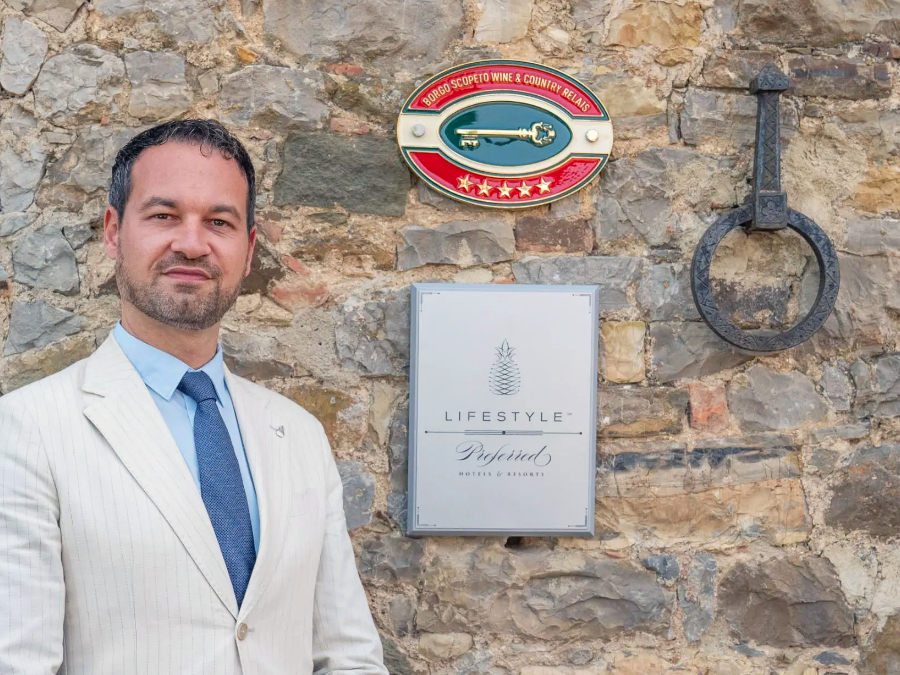
At first, that may sound philosophical, but as you walk through the estate, you begin to understand why the Ethical Luxury Protocol was created. In a place where the same hills have shaped the horizon for nearly a thousand years, and where vines and olive trees have drawn life from the same soil for generations, luxury can no longer be defined simply in terms of comfort or privilege.
Here, true luxury is time. The opportunity to step away from the constant noise, to watch a sunset without looking at your watch, for dinner to become not just another item on the day's schedule, but a celebration of its end. For the landscape not to serve merely as the backdrop to a photograph, but to become something with which we form a genuine connection.
The core idea behind the Ethical Luxury Protocol is built on exactly this principle: true luxury lies not in opulence, but in balance. The balance between excellence, respect, and responsibility. Responsibility not only toward guests, but also toward the people who make the hotel possible, and toward the landscape and the local community from which this experience is born.
Perhaps that is precisely why the idea feels so authentic. It was not a decision made for profit. It does not follow a trend. It is not the product of a marketing campaign.
As the hotel's director explains, the protocol emerged from a long process of observation and understanding, during which he came to know the estate, the people who work here, and the land of which Borgo Scopeto has been a part for centuries. The goal was not to create a new slogan, but to develop a philosophy that would be reflected in everyday decisions.
And once you know this, you begin to see the details differently. The lavender fields are not there simply because they are beautiful, but because they are part of the estate's natural ecosystem. The bees support biodiversity. The ingredients come from local producers. The vegetables are grown in the estate's own garden. There are water management systems, solar energy, and countless small, almost invisible decisions that all point in the same direction: ensuring that what we experience today will still exist tomorrow.
But perhaps the most interesting thing is this: in the end, the Ethical Luxury Protocol is not really about the environment, nor is it about luxury. It is about people: About a feeling that everyone hopes to find when they travel to Tuscany, yet rarely experiences in such a pure form, the feeling of having truly arrived.
When, on a summer evening, the golden light slowly fades above the pool; when the steady song of the cicadas blends into the silence of the distant hills; when the air is filled with the scent of lavender, rosemary, and sun-warmed earth, you realize something.
Luxury is not necessarily about having more, sometimes it is about having less. Less noise, less rushing, fewer distractions. More attention, more presence. A deeper connection with the place where you are.
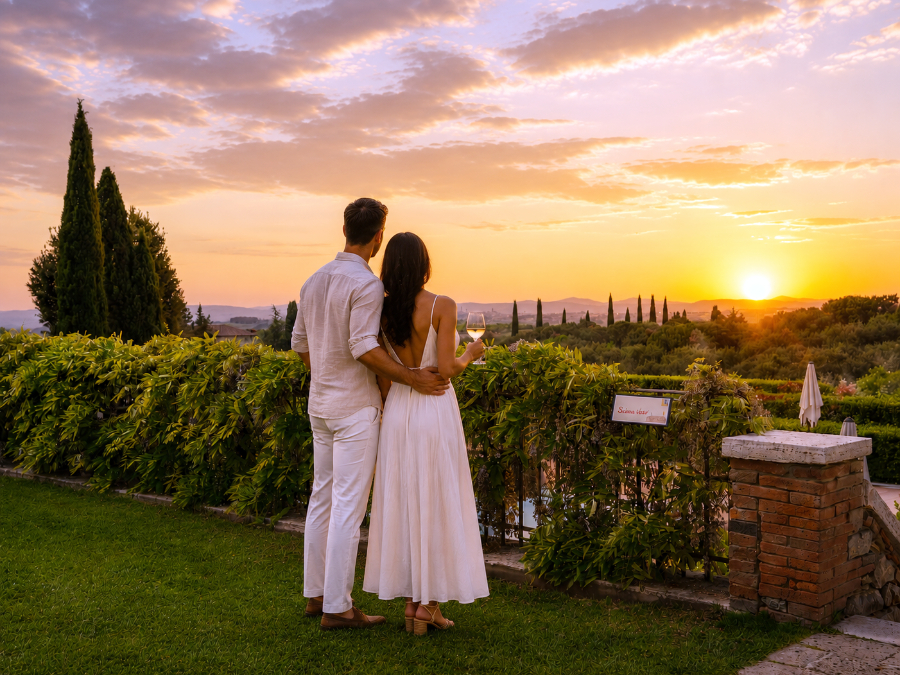
That is why the Ethical Luxury Protocol fits so naturally into the story of Borgo Scopeto. It is not a separate initiative added later to the estate's identity, but rather, it builds upon an idea that has always been there, hidden within every stone wall, every cypress tree, every glass of Chianti, and every Tuscan sunset.
True luxury should never distance us from the world. It should bring us closer to nature, to people, to life's most precious moments, and ultimately to ourselves. Because it is there, in that quiet place of presence, that the deepest expression of a fulfilled life begins: gratitude.
And gratitude, in the end, is the true source of happiness. Curiously, gratitude does not arise when we receive more, but when we learn to appreciate more deeply what we already have. If we have not yet discovered that feeling, perhaps a few days at Borgo Scopeto can help us find it in our own lives. It is a thought that could well serve as the motto of the hotel's ethical philosophy: "Luxury is not having more than we need. Luxury is having the time and the presence to recognize how much we already have."
Borgo Scopeto Wine & Country Relais
Borgo Scopeto - 53019
Castelnuovo Berardenga (Siena)
+39 0577 320 001
info@borgoscopetorelais.it